Sixty-eight percent of all Google searches end without a click, reports one headline. “Zero-clicks fall to 27.6 percent,” runs another. Both appeared about the same study. Both sound precise. Anyone trying to base a budget decision on them is left high and dry.
This is exactly the spot many B2B leaders are in right now: AI search is visibly changing how prospects research, and for every position there is a study with the matching number. That is rarely down to poor research. The studies measure different things, and the measurement infrastructure no longer captures a growing part of what happens at all.
This article shows why the numbers contradict each other, at which three points your measurement chain breaks, and which four figures let you measure traffic impact and AI visibility reliably anyway.
One study, two different takeaways — now what?
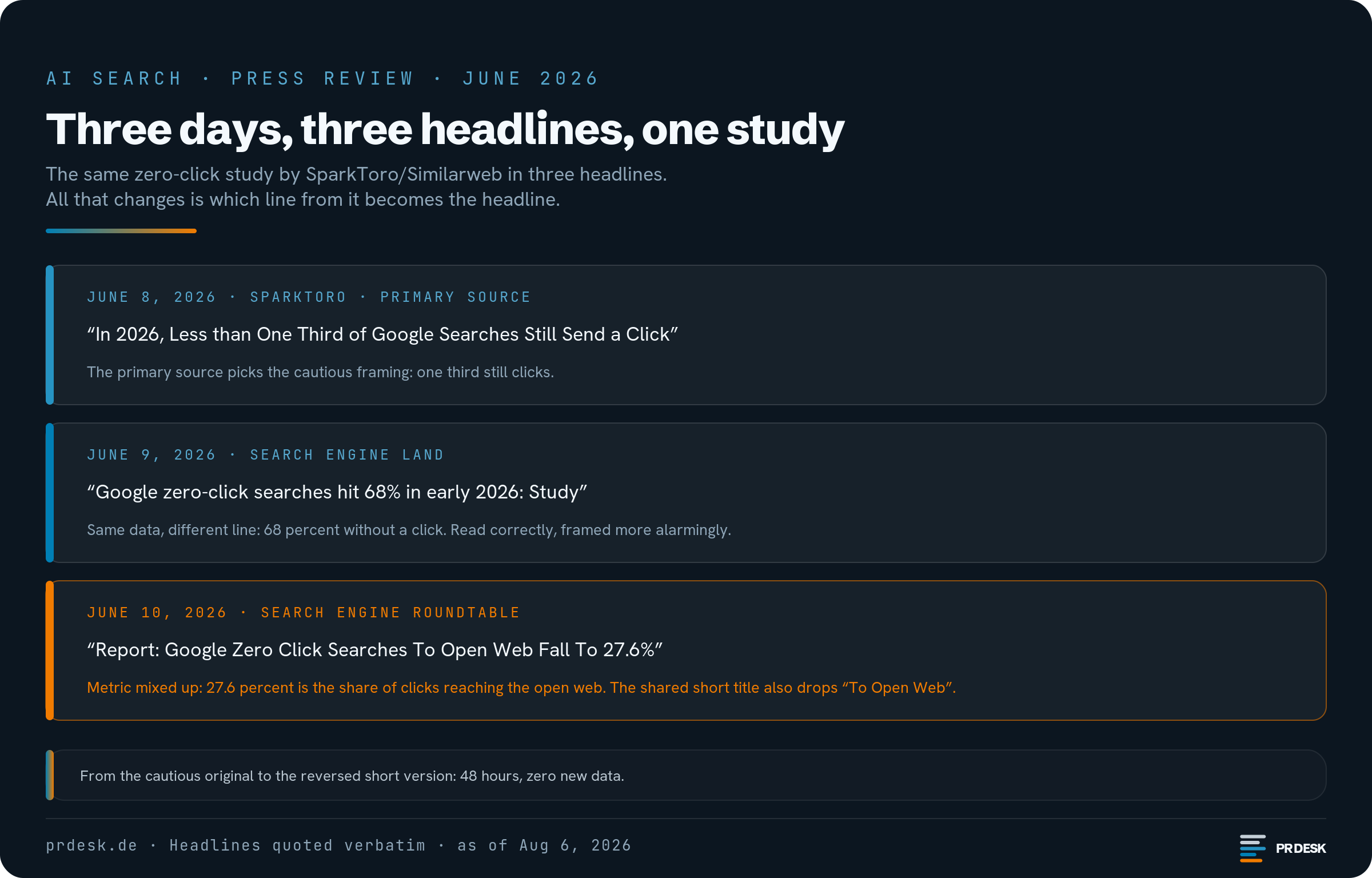
In June 2026, SparkToro published the current zero-click analysis using Similarweb data: 68.01 percent of US Google searches between January and April 2026 ended without a click. Of every 1,000 searches, only 276 clicks still reach the open web. In 2024 it was 374.
The trade publication Search Engine Roundtable circulated the piece under the headline “Google Zero Click Searches Fall To 27.6%.” On the article page itself, the headline still carries the qualifier “To Open Web”; in the shared title it drops off. The 27.6 percent comes from the same table. It quantifies the share of clicks that reaches the open web. So one dataset produced two opposing messages: zero-clicks rise to 68 percent, and zero-clicks “fall” to 27.6 percent. The measurement gap does not begin only in the methodology. It begins with the reading.
Four methods, four different results
Even where the work is clean, incompatible results emerge. Four examples from the past twelve months:
- SparkToro/Similarweb evaluates panel data, US only: 68 percent zero-click; AI Overviews appear on more than one in five searches and then depress the click rate by around 60 percent.
- Pew Research observed the real browsing behavior of 900 US adults across some 68,000 search queries: with an AI summary present, a click on a search result followed in 8 percent of cases; without one, in 15 percent. Google publicly rejected the methodology as flawed. Pew stood by the numbers.
- Ahrefs measures the click rate of the top-ranked page for queries with an AI Overview. The reported declines range, depending on the survey period, from around a third to slightly more than half.
- Seer Interactive tracks a Search Console time series: minus 61 percent organic click rate for affected queries. The same source simultaneously reports that the click rate of the AI Overviews themselves nearly doubled within two months, from 1.3 to 2.4 percent.
A panel, a behavioral observation, a CTR model, a Search Console time series. All four point in the same direction. None is comparable to any other, and the platform operator disputes them all.
Where the measurement chain breaks
The deeper reason for the contradiction lies in the infrastructure. Three break points decide what reaches your analytics in the first place.
First, the referrer: Google Analytics sorts clicks from Google’s AI Mode into the “Organic Search” channel, together with the classic search results. You cannot see them separately there. With AI assistants such as ChatGPT, on the other hand, the referrer is often missing. In an April 2026 snapshot, the analytics provider Clickport assigned sessions to AI search and found no referrer for 35.7 percent of them. Only a source tag revealed where they came from. That is vendor data, and a second vendor, using a different method, arrived at a figure roughly twice as high.
Second, the Search Console: it does not separate clicks from AI Overviews from classic organic clicks. What you report as “Google Organic” contains a growing, unknown AI share.
Third, the assistants themselves: ChatGPT appends the source tag utm_source=chatgpt.com to links from its search. The citations in its answers carried it even before June 2025, and since then the list of further sources has carried it as well. Without tag and referrer, Google Analytics has no way of knowing the visit came from ChatGPT: it books the visit as “Direct,” in the same bucket as bookmarks and typed-in addresses, or credits an earlier source of the same user.
What is left of the decimal-point precision of the headlines? Little. Anyone who states their own “traffic loss from AI” exactly is quantifying a figure that their measurement chain, in part, cannot even see.
AI visibility is not a single metric
Even the counter-move has a catch. Whoever says “then we’ll just measure AI visibility” is measuring five different things. SEO expert Matthäus Michalik (Claneo) spent 30 days evaluating, for an in-house agency project, which domains the major systems pull as sources. His hands-on analysis: AI Overviews and AI Mode share 31.1 percent of their source domains, the most similar pair in the set. ChatGPT and Gemini share 7.1 percent. Counted by citation volume, meanwhile, 58 to 93 percent of citations per pair of systems run through domains both systems know. Michalik describes a hard core of around 100 domains that appear in all five systems.
A single “AI visibility” value hides this structure. You measure per system, or not at all.
Best practice: how we measure at PR DESK
We apply this critique to ourselves first. In our Content Pipeline we measure the AI visibility of prdesk.de separately per channel — our generative engine optimization (GEO) measurement protocol — as frozen test questions with documented pulls. The reading on August 2 taught us three things that appear in no study headline:
- Same question, same day, identical parameters: two Perplexity citations one time, zero the next. A single pull can flip the result. We therefore report pull series with stated variance and treat every point measurement as a snapshot.
- Ranking and citability diverge. Our post at Google position 5 takes 7 of the 12 organic clicks in the period and is cited by no AI channel. A post at position 35 is cited. Anyone who steers AI visibility by Google positions is steering past the target.
- A zero is not always a zero. On two of our three test questions, ChatGPT did not search at all despite the search instruction. That zero says nothing about our findability. It says the system skipped the search.
My recommendation: Before any budget decision, first ask how a traffic figure was measured. That one question costs you five minutes. And it keeps you from building your content budget on a headline that misreports its own study.
Which AI visibility metrics count, and which ones you can ignore
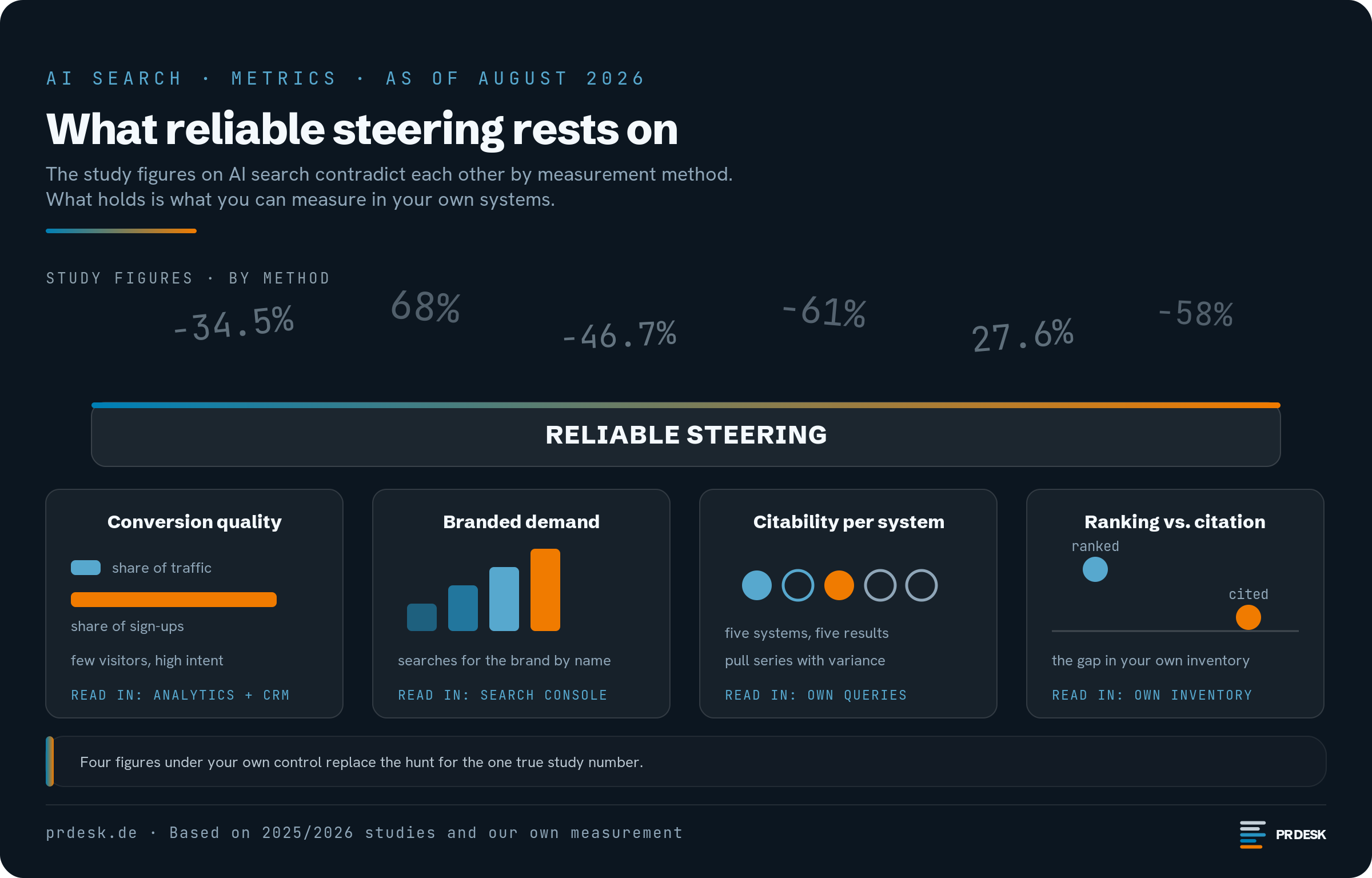
Four metrics (KPIs) count for AI visibility, and you collect all four yourself: conversion quality, branded demand, citability per AI system, and the gap between ranking and citation. Four others you can safely ignore: the single AI visibility score, the exact traffic-loss figure, the Google position as a steering metric, and the single zero reading. They all promise more than they measure.
These four metrics are central to steering:
- Conversion quality over volume. If you only count AI visitors, you can miss their value: in a 2025 Ahrefs analysis, they made up 0.5 percent of visitors over 30 days and brought in 12.1 percent of sign-ups, a single case with first-party data.
- Branded demand, as an indirect value. If someone reads your company name in an AI answer and later searches for it on Google, you see that search in the Search Console, even though the AI answer itself brought no visit. Google omits very rare queries from that report, though.
- Citability per AI system, as a pull series. Each system picks its sources differently, and a single pull can reverse the result. The value only becomes robust as a series of several pulls per system, with variance stated.
- The gap between ranking and citation. It shows which posts bring clicks and which ones the AI systems use as a source. In our own measurement, these were different pages.
The second list is the less comfortable one, because its numbers look so nicely precise:
- A single AI visibility score. It folds systems with only partly overlapping sources into one number, which makes it like a thermometer reporting the average of a sauna and a refrigerator.
- The exact traffic-loss figure from AI. It quantifies something your measurement chain cannot cleanly separate: the Search Console counts clicks from AI Overviews and AI Mode together with the other clicks from web search.
- The Google position as a steering metric for AI visibility. It remains important for your organic traffic but says little about citations in AI answers, as our post at position 5 without a single AI citation shows.
- A single zero reading. A zero can also mean that the system did not search at all: on two of our three test questions, ChatGPT skipped the web search despite the search instruction.
How far Google rankings and AI citations diverge is shown in our German-language article SEO vs. GEO.
That is the central insight of this review of the studies: there is no single true traffic-loss number. Reliable steering emerges from the interplay of the four metrics named above.
The two headlines from the start both remain true, by the way, as readings of the same table. A figure becomes reliable only through the measurement path behind it. Whoever knows their own measurement chain can steer.
This article was produced with AI: it did the research and wrote the first draft. At fixed gates, its claims were checked against their sources, and I decided on the final text. This English version is translated from the German original. In October 2026 we updated both versions the same way, adding the section on metrics, a revised paragraph on the referrer, and more precise details on source tags and source overlap.
Sources: SparkToro/Similarweb, “In 2026, Less than One Third of Google Searches Still Send a Click,” June 8, 2026 · Search Engine Roundtable, “Google Zero Click Searches To Open Web Fall To 27.6%,” June 10, 2026 · Search Engine Land, “Google zero-click searches hit 68% in early 2026: Study,” June 9, 2026 · Pew Research Center, July 22, 2025 · Ahrefs, AI Overviews CTR study, March 2025 · Seer Interactive CTR data via Search Engine Land · Ahrefs, AI search traffic conversion analysis, June 2025 · Clickport, ChatGPT direct-traffic attribution data, April 2026 · Hands-on analysis by Matthäus Michalik/Claneo, August 2026 (in German) · PR DESK GEO measurement protocol, reading 2, August 2, 2026 (internal).
Aus Ihrem Fachwissen wird ein Content-System. Lassen Sie uns klären, welches Thema Ihre erste Content Pipeline trägt. Erstgespräch vereinbaren →